




The Miami City Commission is set to vote on a zoning change that could open hundreds of civic-zoned properties — including churches, schools and hospitals — to residential development.
The Miami City Commission will consider a far-reaching zoning change on Thursday that could allow residential development on hundreds of properties citywide controlled by religious, educational or government entities.
The measure – which commissioners tabled prior to a vote last month – includes a change that could expand the pool of qualifying properties.
Under the proposal, properties zoned Civic Institution, or CI, would be permitted to develop residential housing without a rezoning or a separate policy vote on land use — a process that typically involves public hearings and the ability of neighbors to formally challenge or appeal decisions.
City officials say they hope to encourage housing on what, in some instances, may be swaths of underutilized land controlled by churches, schools and other nonprofits.
The allowable number of residential units per acre would match the most restrictive density of any zoning district that borders the property; in cases where a CI parcel abuts single-family neighborhoods, the site would default to T4 density — 36 housing units per acre.
Miami has 668 such CI-zoned properties, ranging from churches and private schools to hospitals and government entities.
Under the revised language before commissioners Thursday, a property zoned Civic Institution would not be required to contain a church, school or other institutional building on the site itself.
Instead, eligibility has been clarified to include CI properties owned, controlled, or legally affiliated with a religious, educational, nonprofit or governmental entity — a distinction that could bring additional properties under the ordinance’s umbrella.
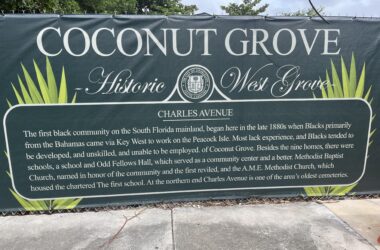
In Coconut Grove, the most obvious beneficiary of the new law would be the 72-acre, waterfront parcel on South Bayshore Drive controlled by the Catholic Church’s Archdiocese of Miami and currently occupied by the for-profit HCA Florida Mercy Hospital and Immacolata-La Salle High School.
In the mid-2000s, a controversial proposal to build three luxury high-rise towers on the parcel, adjacent to the hospital, was defeated after strong neighborhood opposition over traffic, building scale and infrastructure capacity.
An HCA Florida Mercy Hospital spokesperson declined to answer questions, citing the pending legislation. The Archdiocese of Miami did not respond to a request for comment.
While the ordinance mandates that residential projects include some workforce housing – defined as units attainable for households earning between 100 percent and 140 percent of Area Median Income ($86,800 to $121,500 for a single person in Miami-Dade) – it does not specify how many units must be set aside, what percentage of a project they must represent, or how long those units must remain priced at workforce levels.
Nor would the measure require any units to be affordable to lower-income households, typically defined as those earning 60% to 80% of area median income, or about $52,000 to $69,000.
An earlier version of the proposal limited development rights to properties “owned or controlled” by a religious institution, nonprofit, school or government entity.
The version now before commissioners would also extend those rights to private developers that are “affiliated by legal instrument” — such as through a ground lease, joint venture or management agreement with those institutions.

















This is yet another gift to the developers which will harm our quality of life with more overcrowding, traffic and other impacts on our infrastructure.
The City is obsessed with infinite growth, regardless of the harm it does.
Once again we have government of developers, for developers, by developers.
This vote will show which commissioners care about the residents more than pleasing developers.
Bingo.
Good news: The City Commission voted down this proposal.
Christine King was quite adamant in her opposition.
Final vote was 4-1 against.
Keep an eye on this one. In a letter from Ralph Rosado’s chief of staff, he indicated they intend to “refine the legislation, and bring it back before the Commission”